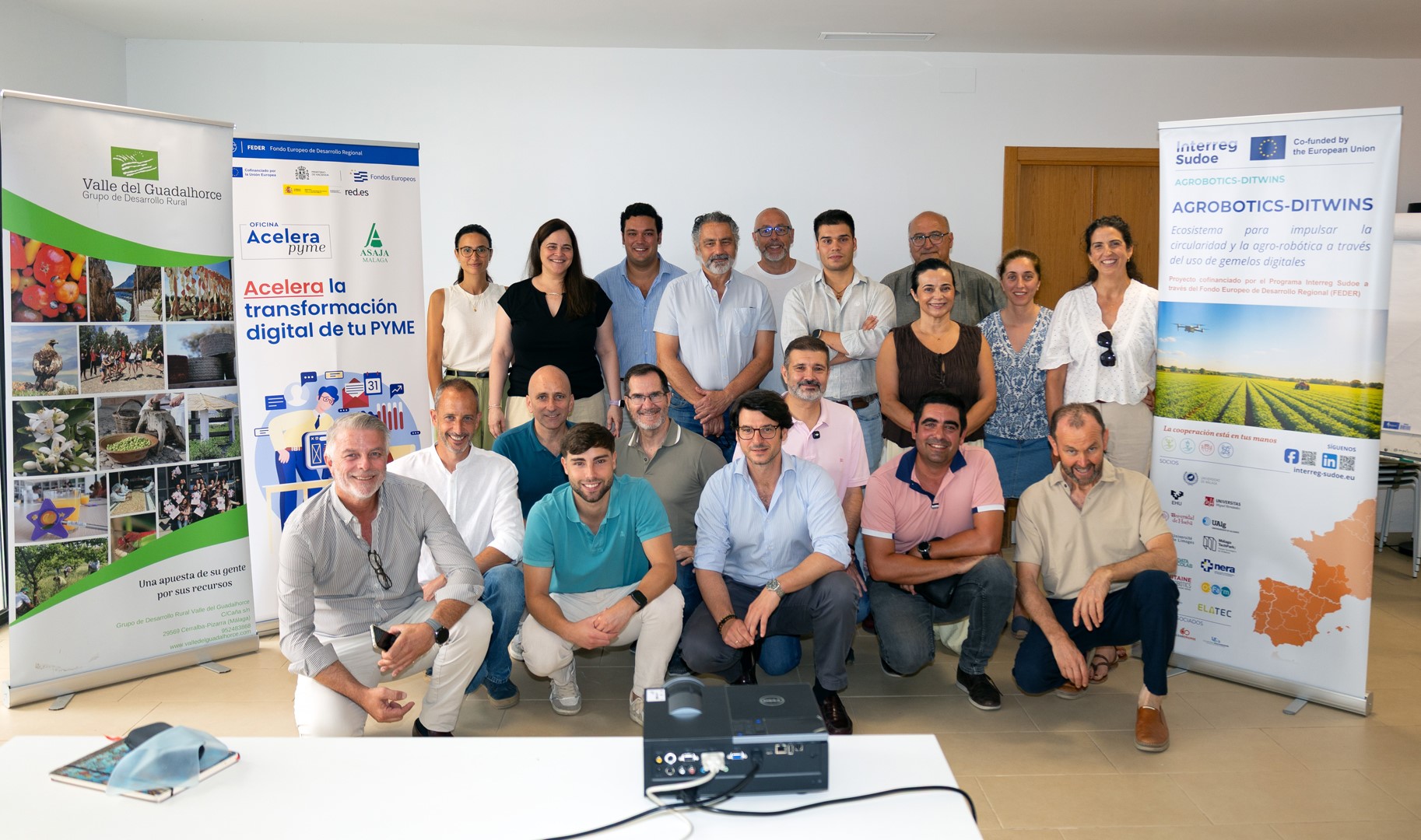
On Wednesday, 24 June, Málaga TechPark and the University of Málaga held an in-person meeting at the Rural Development Group – GDR Valle del Guadalhorce under the title “Robotics and digital twins for the agricultural sector”. The event, organised in collaboration with GDR Valle del Guadalhorce and the Young Farmers’ Agricultural Association – ASAJA Málaga, brought together 20 participants from companies, cooperatives, agricultural organisations and local stakeholders interested in exploring new opportunities to incorporate robotic, digital and digital twin-based solutions into the agricultural sector.
The session took place within the framework of the European project Agrobotics-DiTwins, funded by the Interreg Sudoe programme, in which Málaga TechPark participates alongside partners from Spain, France and Portugal. The project aims to promote the adoption of robotic technologies in agriculture in order to improve the productivity and efficiency of farms while reducing their environmental impact.
During the meeting, the project’s approach was presented, along with the role of the Living Labs as spaces for experimentation, analysis and validation of technological solutions applied to real challenges in the agricultural sector. Through the use of digital twins, Agrobotics-DiTwins enables potential solutions to be analysed, simulated and evaluated before significant investments are made in time, resources or equipment.
The event began with a networking breakfast and a welcome by GDR Valle del Guadalhorce, followed by a presentation of the Agrobotics-DiTwins project. Afterwards, ASAJA Málaga presented its ongoing projects and advisory services for the agricultural sector. A use case on the automation of an agricultural process was also presented, showing in practical terms how robotics and digitalisation can help address specific challenges faced by farms.
One of the central moments of the meeting was the participatory dynamic focused on identifying agricultural processes with potential for automation. The participating companies and organisations worked on real operations from their own activities, analysing repetitive tasks, labour-intensive processes, resource consumption, data needs and potential areas for improvement. This dynamic made it possible to gather valuable qualitative input for the project and to identify potential initial simulation cases within the framework of the Living Labs.
The session took place in a participatory atmosphere and enabled direct exchange among the attending organisations. The involvement of participants enriched the discussion and helped identify real needs within the local agricultural sector, as well as possible lines of work for future project activities.
The meeting concluded with the presentation of the project’s next steps and the possibility for interested organisations to continue collaborating through future technical interviews, visits or pilot activities. These actions will support progress in the definition of use cases and in the assessment of robotic and digital solutions adapted to the needs of agricultural holdings.