
-
AGPhotonics relocates its headquarters to a larger university building within Málaga TechPark, strengthening its cutting-edge ecosystem for the microelectronics industry
AGPhotonics, a knowledge-based company established as a University of Málaga spin-off in May 2023, has officially opened its new facilities in Málaga TechPark. It is now based in the University Institutes Building, occupying a 600-square-metre facility dedicated to the development of photonic chips, reinforcing Málaga TechPark’s position as a leading ecosystem for the microelectronics industry.
Until now, AGPhotonics was located in the University’s Bioinnovation building within the Park. The move to higher-capacity facilities reflects the company’s rapid growth and the need for technical infrastructure capable of supporting its current and future projects.
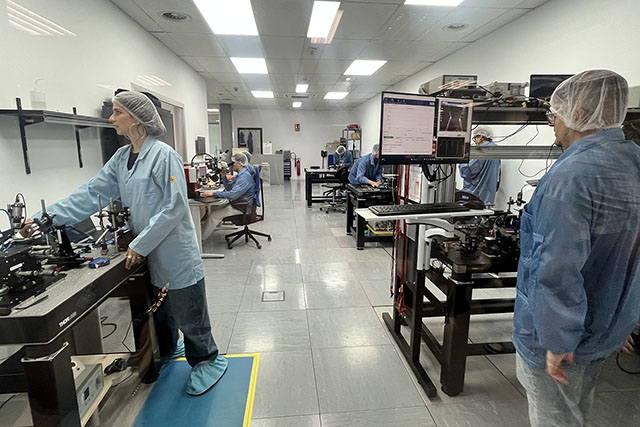
The new space is equipped with a pilot production line, and a dedicated photonic chip characterisation area, together covering more than 200 square metres of laboratory space. It is organised into two specialised areas: a photonic chip characterisation laboratory – equipped for measuring and validating the optical performance of the integrated devices – and a pilot production line, designed for assembling and testing prototypes under operational conditions.
New Facilities
The new premises were officially inaugurated today in a ceremony attended by, among others, Rector of the University of Málaga, Teodomiro López; Mayor of Málaga, Francisco de la Torre; Acting Regional Minister of Economy of the Andalusian Regional Government, Carolina España; Málaga TechPark President, Felipe Romera; Founder of AGPhotonics and Professor of Signal Theory at the University of Málaga, Iñigo Molina; the CEOs of both Andalucía TRADE and AG Photonics, Antonio Castro and Pablo Ginel; and finally, Miguel del Cañizo of Bullnet Capital.
After reflecting on the company’s journey and the milestones that have led to its current position, Carolina España described AGPhotonics as a clear example of how knowledge can transform into a business opportunity, “I congratulate the Rector, since there is no better news for a region than seeing a company grow, and this one, in short, illustrates how innovative ideas become successful businesses”. The mayor congratulated AGPhotonics for its success, as well as its influence within Málaga’s technology ecosystem. For his part, Teodomiro López described the inauguration as “a day of celebration for the University”, before taking the opportunity to call on the Regional Government of Andalusia to provide “the necessary support to grow”.
López also pointed out that Málaga’s population has now exceeded 600,000 residents and “only” has one public university with around 38,000 students, while Seville, for example, with a population of approximately 700,000, has two public universities educating almost 90,000 students. “We need a university with 30,000 more students”, he said, adding that with the increase in funding and capacity “no student from Málaga would have to leave the city simply because there are no university places available”.
This is precisely what the founders of AGPhotonics try to do; help their business continue to grow as it has done in the last two years by employing graduates from the University of Málaga itself, who have, in turn, avoided the need to look elsewhere to put their qualifications into practice.
A Successful Example of Knowledge Transfer
AGPhotonics is a successful example of knowledge transfer between the university and the business sector, born out of the Photonics&RF research team led by Íñigo Molina. The company specialises in a highly disruptive technology: the development of fully integrated silicon photonic transceivers for free-space optical communications.
This innovation is essential in contingency situations or when there is a lack of physical infrastructure, given that it allows for much higher data transmission speeds than what current radio-frequency systems permit. Its technological development has shown outstanding improvements in speed, safety, size, weight and energy consumption. It operates under a B2B model directed at critical sectors such as Defence and telecommunications.
The commercial potential and technical robustness of this project relies on the financial support of Bullnet Capital, a venture capital firm that specialises in high-impact deep tech projects.
During the opening, the important role AGPhotonics plays in attracting and retaining talent in Málaga TechPark was recognised; the company employs more than 20 professionals who specialise in telecommunications, electronics and mechanical engineering. Their contribution to Málaga’s technological ecosystem is clear, since AGPhotonics carries out its activity in close connection to Málaga’s scientific and business ecosystem. It also collaborates with university research teams and technology centres. Its presence in the city contributes, therefore, to consolidating a local technical base in integrated photonics, a field in which the availability of characterisation and prototyping capabilities is a determining factor in the advancement of research and industrialisation projects.
This industrial growth feeds into other significant milestones that strengthen the region’s position as one of Europe’s leading centres for semiconductor technologies. Examples of this include the business accelerator and incubator specialised in semiconductors, Nucleø, which also opened its new facilities today, as well as the upcoming construction of imec’s microelectronic research and prototyping centre, representing an investment of more than €500 million.
The opening of these facilities reflects the Park’s capability for hosting complex industrial projects and advanced technology infrastructure, such as clean rooms and photonics laboratories, in line with its strategic commitment to the microelectronics sector.
This robust and innovative framework establishes Málaga as a global centre for photonics, with recognition extending beyond the business community into leading international scientific and technical forums. Among the most significant are the Global Photonics Economic Forum (GPEF 2026), a strategic summit for CEOs and investors in the sector, and the European Conference on Optical Communications (ECOC 2026), organised by the University’s Photonics & RF Research Lab, which will bring together many of the world’s leading experts in optical communications at FYCMA next September. These milestones demonstrate how Málaga’s integrated photonics ecosystem is creating the ideal environment for internationally successful technology startups.
With the opening of AGPhotonics’ new facilities, Málaga TechPark further reinforces its role as a leading hub connecting investment, science and industry. Today, the park is home to more than 700 companies generating annual revenues of over €4.8 billion and employing more than 29,000 professionals. Through public-private collaboration, technological specialisation and strong links with global networks, the Park continues to strengthen its position as one of Southern Europe’s most dynamic, competitive and influential innovation ecosystems.