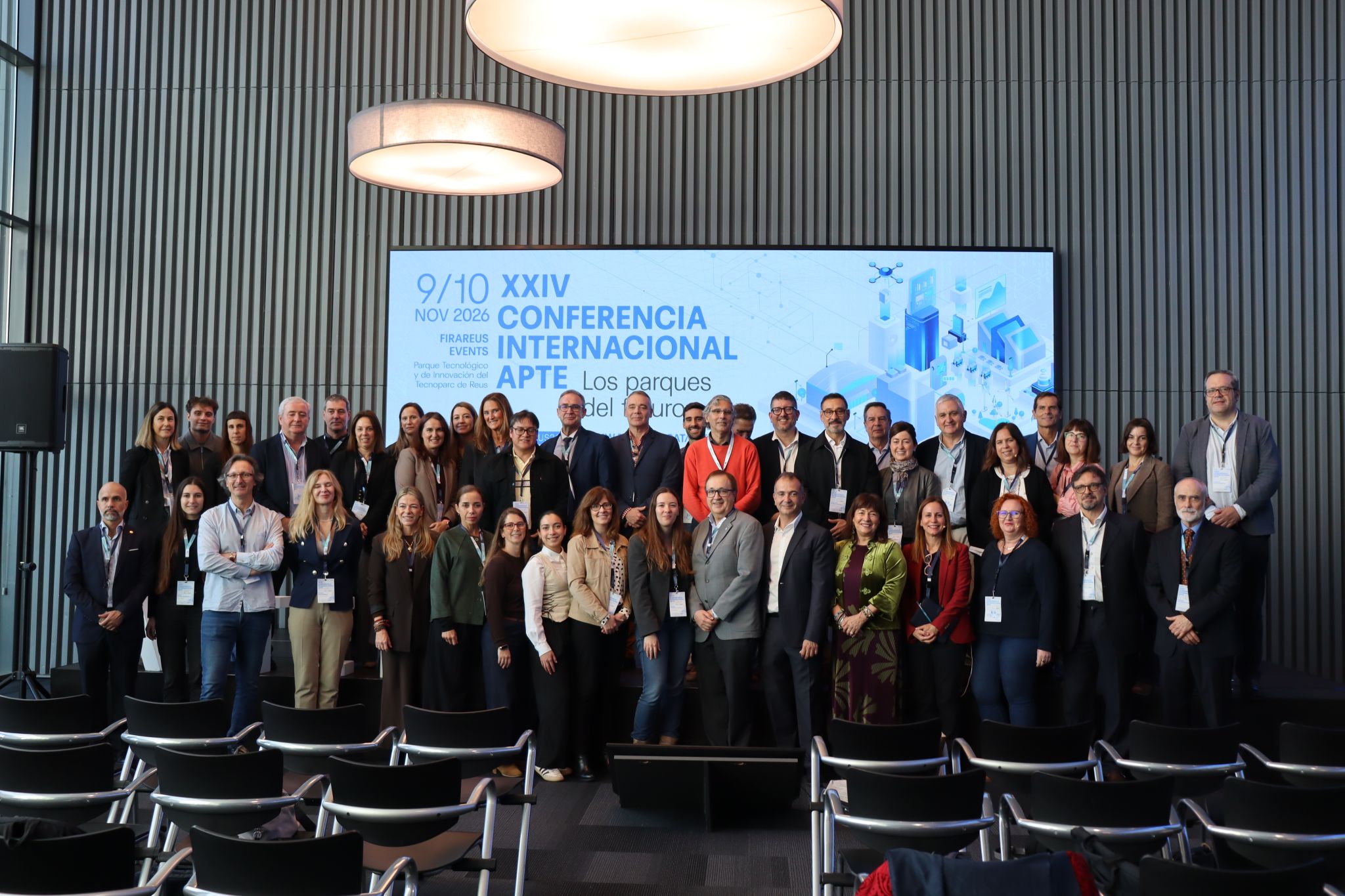
The 24th International Conference of Association of Science and Technology Parks of Spain (APTE), was held on 9 and 10 November in REDESSA Tecno – Tecnoparc Reus and organised in partnership with REDESSA. This event brought together 40 representatives from the national and international innovation ecosystem to reflect on the future of the science and technology parks, and the challenges they face as drivers of economic, technological and regional development.
Under the theme ‘Science and Technology Parks of the Future’, the event addressed issues such as the evolution of park models, the emergence of new strategic sectors, publi-private partnerships and the role of companies, entrepreneurship and talent in boosting innovation ecosystems.
The session on 10 November began with the institutional opening, with the participation of Sandra Guaita, major of Reus; Javier Salva, Director-General for Technological Innovation and Scientific Internationalisation of the Government of Catalonia; and Felipe Romera, President of APTE, who joined remotely.
The opening international presentation was given by Monika Machowska, Deputy Director of the Technology Department at Krakow Technology Park (Poland). She presented ‘Rethinking the Mission of Technology Parks: Insights from Krakow’, a reflection on the evolution of the mission of science and technology parks, drawing on her own park’s experience, and their role within innovation ecosystems. During her presentation, Monika explained how her park has had to learn to manage and anticipate uncertainties, shifting from an innovation support tool to an instrument of regional technological resilience. Events such as the pandemic and the war of Ukraine have reshaped the park’s strategic agenda and forced it to focus on developing new initiatives to help its region reduce technological dependence and adapt to new challenges in the field of defence. According to Machowska, ‘the value does not lie in the infrastructure that the parks have, but in what they can do with it’. She also encouraged attendees to ‘redefine how they measure their results’.
The programme included three panel discussions focusing on different aspects of the parks of the future. The first ‘What will the parks of the future be like? Smart Parks and emerging sectors’, featured Itziar Epalza, Managing Director of the Euskadi Technology Park; Fabio Morea, Head of the Sustainability Unit at AREA Science Park (Italy); and Javier González, Director-General of the Salamanca Science Park. The panel discussion’s key takeaways centred on the importance of science and technology parks of the future shifting from mere energy consumers to energy managers by developing initiatives for energy production, storage and sharing. Regarding specialisation in emerging sectors, everyone agrees that the region itself should dictate this focus. The park must take into account the specific characteristics and needs of the region, providing solutions through the scientific and technological advances developed by the park’s organisations and extending their application to other regions.
In this regard, the conference participants agree that the future science and technology parks should focus less on merely acquiring more technology and more on understanding how to apply it to address challenges, transform, and improve local areas. Consequently, one of the most important activities of these parks is to identify all the existing capabilities within the ecosystem, connect the relevant innovation stakeholders involved in solving challenges and regional transformation, and make these capabilities accessible to them.
The second panel discussion, ‘Public-private Partnership Models for Boosting Innovation. Innovation Districts’, brought together Nuria Trobos, Head of Business Land Development at ICECYL – Technology Parks of Castile and León; Piroska Matos, Head of Business Incentives, Promotion, Growth and Consolidation at Gijón Impulsa; and Eva Martín, Head of Innovation and Projects at Sevilla TechPark. The debate explored different models of cooperation between public authorities, technology parks and other innovation stakeholders to foster the development of innovation ecosystems. Among the panel discussion’s key takeaways was the need to move beyond networking towards results-oriented collaboration. However, the participants agreed that to achieve this, it is essential to identify the interests of all parties when challenges are identified and to ensure that everyone benefits.
Meanwhile, the panel discussion ‘Business, Entrepreneurship and Talent: Three Drivers of the Future of Parks’ focused on the factors that help to strengthen these spaces. It featured Carlos Núñez, Secretary of Málaga Tech; Carmen Adán, Director of La Salle Technova Barcelona; and David Isern, Reus Site Manager at T-Systems. Carlos Núñez explained that one of the key benefits that business parks can offer young talent is to provide a meeting hub where they can engage with innovative projects, companies where they can develop their professional careers without leaving their city, and knowledge-based organisations where they can broaden their horizons. In this regard, he highlighted the importance of parks contributing to the development of bespoke training so that young professionals can respond to the ever-changing needs of businesses. Meanwhile, Carmen Adán pointed out the importance of helping startups scale up by fostering closer collaboration and connection with anchor companies that can pilot and purchase their products and services. David Isern noted that for a company like Tsystem, the greatest benefit of being based in a technology park is the opportunity to present its challenges and receive solutions from the park’s ecosystem.
During the event, the outcomes of the creativity workshop held the previous day, ‘Gaudí Year: How do we envision the Parks of the Future?’, were shared.
This collective exercise has resulted in a manifesto entitled ‘Reus Manifesto for the Science and Technology Parks of the Future’ in which science and technology parks have set out five commitments to be implemented from now on and in the coming years:
- Innovate with nature, not against it.
- Live and work in innovation cities.
- Connect to grow.
- Offer bespoke training.
- Ensure that the parks matter to society.
As part of the pre-event activities, on 9 November, attendees had the opportunity to tour the Tecnoparc Reus facilities, to take part in a creativity workshop and to visit the educational centre at Reus City of Science and Innovation. The day also included various networking sessions and spaces to connect, as well as the APTE General Assembly.
The conference concluded with the presentation of the 13th APTE Best Practise Awards in Science and Technology Parks 2026. In this edition, first place was jointly awarded to Espaitec, Science and Technology Park of Universitat Jaume I, for the initiative ‘Newsletter Talent Espaitec’, and the Alicante Science Park, for ‘Innovating with civil society’.
The second place went to the «Breakfast4inno: El espacio de conexión», for the initiative, ‘Eguskideak Energy Community – Zamudio/Derio Campus’, and to the Lleida Agrifood Science and Technology Park, for ‘Breakfast4inno: the connection space’.
Meanwhile, the award for the most active parks in the APTE Technicians Network during 2025 was assigned to the Extremadura Science and Technology Park.
Finally, the media recognised at the 9th APTE Awards for the Promotion of Science and Technology Parks in the Spanish Press 2026 were Estrategia Empresarial, in the national print media category; iymagazine.es, in the national digital media; El Comercio, in regional/local print media; and TeleElx, in regional/local digital media.
After the award ceremony, the APTE International Conference flag was handed over to Adrián Escardino, Innovation Specialist at the Polytechnic City of Innovation, which will host the next edition of the event on 2 and 3 June 2027.
The closing event had the participation of Itziar Epalza, APTE’s First Vice-President, and Josep Baiges, Councillor for Economic Promotion, Innovation and Knowledge at Reus City Council and Chief Executive Officer of REDESSA.