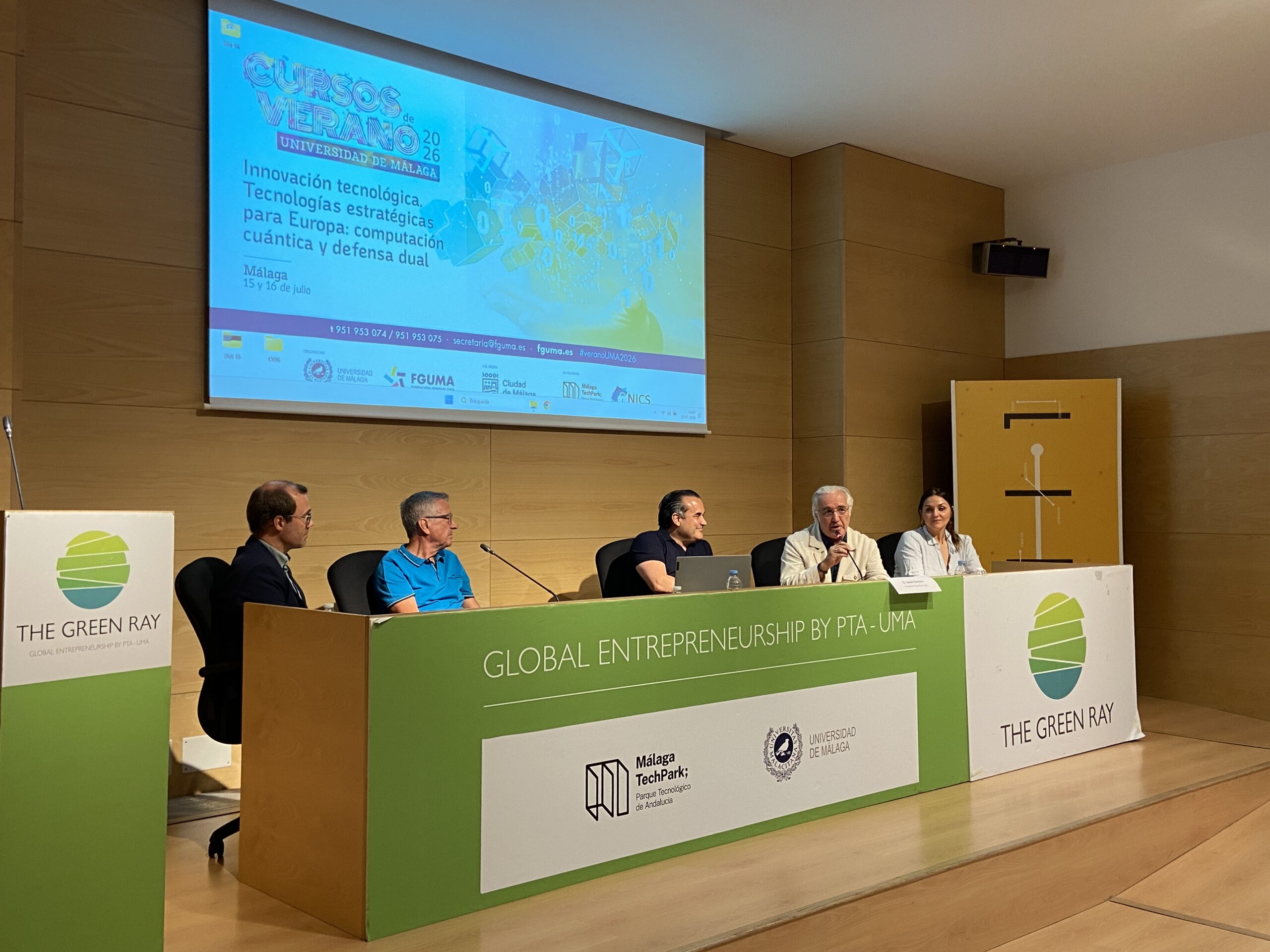
- The Green Ray building hosted the first two sessions of this training event, where Málaga TechPark and UMA innTech brought together experts and institutions to analyse how scientific research is being translated into the business world
Málaga TechPark and UMA innTech launched the first session of their summer course centered on technological innovation, quantum computing and dual-use defence, organised in collaboration with the General Foundation of the University of Málaga (FGUMA) and sponsored by NICS Lab. The event reinforces both Málaga Tech Park and the University of Málaga’s position as leaders of a strategic field that will play a defining role in Europe’s future.
During the opening session, participants explored how quantum technologies are reshaping key sectors such as artificial intelligence and advanced materials. The two-day programme, which concludes on Thursday 17 July, further demonstrates Málaga TechPark’s commitment to establishing itself as southern Europe’s leading technology and innovation hub for key technologies.
The event opened with welcoming remarks from Felipe Romera, General Director of Málaga TechPark, alongside Javier López, Director of UMA innTech and Vice Chancellor for Technological Innovation and Strategic Projects at the University of Málaga, and Macarena Parrado, Deputy Director of the General Foundation of the University of Málaga.
Representatives from Red.es, the public body attached to Spain’s Ministry for Digital Transformation and Public Service through the Secretariat of State for Digitalisation and Artificial Intelligence, examined the boost these emerging technologies are giving to strategic sectors of the economy.
The academic and technical programme continued with Emilio López Zapata, Professor of Computer Architecture at the University of Málaga, who explored the relationship between high-performance computing and next-generation computing architectures. He was followed by Anders Möller, an executive at DEKRA, who addressed the critical challenges of security, certification and both civilian and military applications in today’s digital landscape.
Following a short break, the programme shifted its focus to real-world business applications. Sara Guzmán, Manager at Quside, explained how quantum entropy has evolved from laboratory research into a technology with significant implications for European digital sovereignty. Javier Romero, President of Quantum Labs, then highlighted Málaga’s growing quantum ecosystem, demonstrating how these technologies are already a tangible and operational reality within the region.
The day’s programme concluded with a comprehensive panel discussion moderated by Luis Fernández from SIC magazine, bringing together all of the day’s speakers to discuss when industries are likely to gain a genuine competitive advantage through the adoption of these emerging technologies.
The second and final day of the course will focus on cyber defence and dual-use technologies. Participants will include Vice Admiral Javier Roca, representing Spain’s Joint Cyber Command within the Defence Staff, who will present a comprehensive overview of the level of preparedness against cyber threat, and Luis Fernando Álvarez-Gascón, General Manager at GMV, who will analyse the dual-technologies market and innovation trends.
Javier Bermejo Higuera, Head of the ICT Department at Spain’s National Institute for Aerospace Techniques, will also discuss the practical application of artificial intelligence in military operations. Following a break during which an important institutional agreement will be signed, the programme will continue with presentations on defence challenges by Fernando Chacón of CGS Ingeniería and Gonzalo León from the Technical University of Madrid. Antonio Ramírez Jiménez, from Indra, will then describe in detail the immense potential of satellite platforms. The event will conclude with a high-level panel discussion on European technological sovereignty, moderated by Luis Fernández of SIC magazine.
The organisation of training initiatives of this calibre further strengthens Málaga TechPark’s position as a high-value public-private ecosystem, attracting profitable investment and projects focused on disruptive technologies such as microelectronics, cybersecurity, defence and artificial intelligence.
Today, Málaga TechPark is home to more than 719 companies, generating annual revenues of over €4.8 billion and employing more than 29,000 highly skilled professionals.
Built on collaboration and knowledge transfer, the Park’s model not only drives industrial transformation by attracting leading companies from around the world, but also serves as an undisputed destination for global talent, offering researchers and professionals a unique environment where world-class career opportunities are combined with an exceptional quality of life.