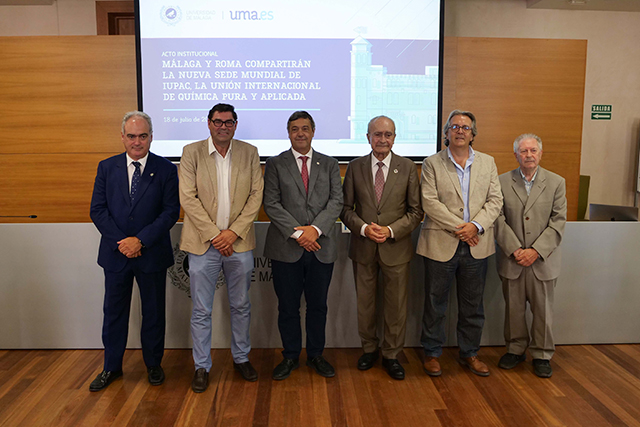
- The announcement was made at the Rectorate, where the authority’s Málaga office will be physically located
Málaga and Rome will share the new global headquarters of the International Union of Pure and Applied Chemistry (IUPAC), the organization that governs and manages advances in chemistry worldwide, composed of over 2,000 members from 57 different countries.
The IUPAC Secretariat, serving as the administrative and technical center of the Union, is relocating after nearly 30 years based at the Research Triangle Park in North Carolina (USA). The selection process began in June 2024, with proposals submitted by a dozen countries from Asia, Europe, and the Americas.
Ultimately, the General Assembly of the IUPAC decided on July 16 to establish the new shared headquarters between Málaga and Rome, specifically at the University of Málaga (UMA) and the National Research Council (CNR) of Italy.
The announcement was made public this morning at the Rectorate of the UMA, where the headquarters will be physically located, by outgoing IUPAC President and University of Alicante professor Javier García-Martínez, who congratulated the choice of the city and university in a video message.
García-Martínez highlighted the strong support provided by the new host institutions for the Union’s administrative operations. In the case of Málaga, he emphasized its importance as a leading technology hub in Spain, “with a well-developed ecosystem of academic, industrial, and governmental collaborations, offering a unique opportunity to connect the Union with Spanish-speaking chemists.”
“This is extraordinary news and a tremendous opportunity for Spanish scientists to interact with some of the world’s leading chemists, who will be meeting and operating out of Málaga,” he stated.
Institutional Ceremony
The event was chaired by UMA Rector Teodomiro López, who was joined by Málaga Mayor Francisco de la Torre. Also in attendance were members of the university’s leadership, deans and department heads, researchers, local authorities, institutional representatives, business leaders, and members of civil society.
The mayor emphasized the importance of this designation, “which will help the city enhance its international profile with the support of the University.”
Rector López praised Mayor De la Torre’s efforts in securing the designation. He also expressed his “euphoria” at the news, “as rector, as a Malaga native and as a chemist.” “This is a historic day for the University.” “A significant part of chemistry’s future in the Spanish-speaking world will be decided here,” he concluded.
Javier López, UMA’s Delegate for Technological Innovation and professor in the Department of Languages and Computer Science, explained the university’s role in hosting the IUPAC headquarters in Málaga.
“It hasn’t been an easy or quick process,” he began, outlining the steps taken since work on the proposal began in June 2024, after expressions of interest from the City Council, Málaga TechPark, and the University, along with the rigorous requirements involved.
He also highlighted the strength of UMA’s chemistry research groups and the support from the Faculty of Sciences.
Next steps include the signing of the UMA–IUPAC agreement in September, transfer of functions in October, physical and operational setup on the third floor of the Rectorate in January, and the official opening of the office during the first quarter of next year.
Global Authority
IUPAC was founded in 1919 by chemists from academia and industry. Over the past century, the Union has established the common language of chemistry, developed standards, verified data, and promoted best practices in the field. It has also worked to foster chemistry education and collaboration between universities and the chemical industry.
IUPAC is the global authority responsible for recognizing and naming chemical elements, organizing them in the periodic table, and identifying the top 10 emerging technologies in chemistry.
Today, the International Union of Pure and Applied Chemistry is focused on aligning with the Sustainable Development Goals, integrating artificial intelligence into chemistry, and promoting diversity in the field.
Since its inception, the IUPAC Secretariat has rotated among member states, reflecting the organization’s global character. After being based in Paris before and after World War II, it moved to Zurich and Basel in the 1950s and 60s, then to Oxford (UK) in the mid-60s, and finally to North Carolina in 1997, until now, marking the beginning of a new chapter with its shared headquarters at the University of Málaga and the CNR in Rome.